


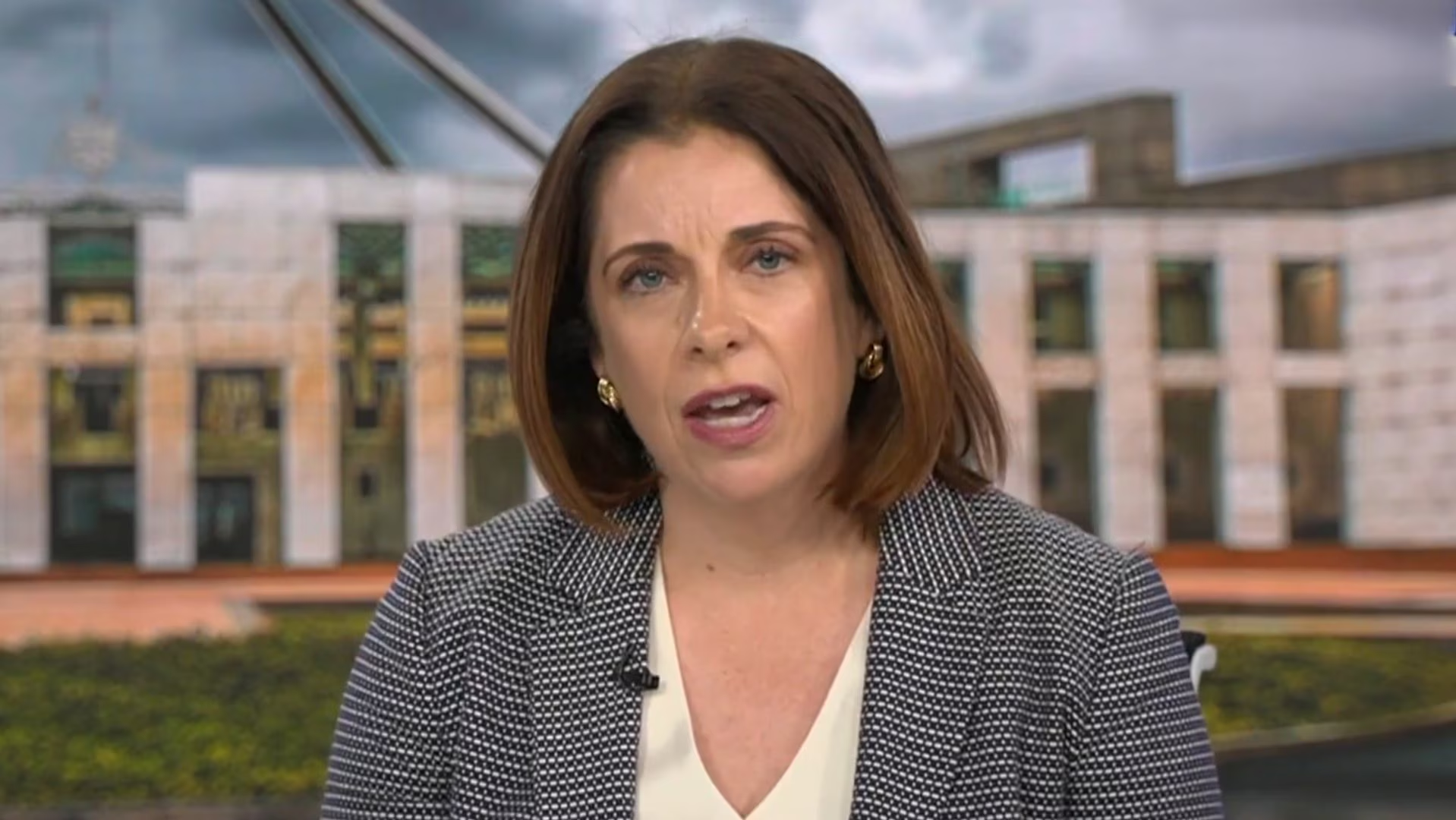
A “safety net upstream” – that’s how Australia’s Communications Minister Anika Wells described the intent behind the Online Safety Amendment (Digital Duty of Care) Bill 2026, introduced to the country’s Parliament on Thursday.
Wells was making the announcement hours before she was to address the National Press Club. The bill, which is 90 pages long, carries a civil penalty of up to 60,000 penalty units, or $109.2 million, for failing the duty.
In Parliament, Wells said, “It moves the safety net upstream to the people who design the product to stop the harm before it ever reaches an Australian.”
At the Press Club, she put it this way: setting “basic safety standards for the online services we use every day” will see the platforms regulated “just like we have in every other industry.”
Wells said that the goal is to “shift the burden from the shoulders of victims to the companies that are creating the environments where harms occur.”
She added: “To make this abundantly clear, we have removed the ministerial rule-making power to define new harms in the final bill.”
Instead, she said, “New harms can be added by parliament through legislative amendment.”
The takedown changes in Schedule 1 kick in the day after Royal Assent, while the duty of care itself comes into force 12 months later.
In September, the exposure draft gave the minister the power to add, by instrument, any material “that the Minister is satisfied may cause serious harm.” That power is now gone.
The bill does not at any point ask platforms to balance their “duty of care” with the need to protect freedom of expression and privacy of users.
Section 26 sets the duty: a platform “must take appropriate action to ensure a safe online environment, including by taking effective measures to mitigate risks.”
Section 26A spells out what counts as “appropriate” and “effective.” The matters to be taken into account “include” how far the measures achieve “a safe online environment,” how much they reduce the risk of harmful material, “the impact on the security of the online service,” and “whether the action or measures are or would be proportionate to the level of risk.”
Section 26A(3) states: “The cost of the action or measures must not be taken into account.”
Nowhere in this is freedom of expression or privacy mentioned. The word “encryption” does not appear at all in the 90 pages, nor do the phrases “freedom of expression” or “free speech.”
In the UK Online Safety Act – which is no friend of free speech, either – there is at least a section (22) that imposes on platforms, when deciding on safety measures, “a duty to have particular regard to the importance of protecting users’ right to freedom of expression within the law,” and a matching duty on privacy.
The Australian bill has no such provision.
In fact, nobody has to “order” over-removal – the way the legislation is written is enough to make it happen. And it will happen because a platform that removes too much content will not be punished or fined; but one that doesn’t comply and removes too little, can be.
This is not an original observation, either – the US government, in its submission to the September consultation, said, “A framework that empowers governments to enforce vague definitions of ‘harm’ risks becoming a mechanism for viewpoint-based censorship, as platforms will be incentivized to over-moderate speech that should be protected to avoid regulatory penalties.”
This is a classic case of a chilling effect. But Minister Tanya Plibersek, when asked about it, had this to say: “Oh, I really do think that’s, you know, it’s like saying – what would stop a platform from showing fairies.”
Plibersek: “There are all sorts of claims about this being about censorship. It is simply not.”
Wells said at the Press Club that the ministerial power to define new harms has been removed. But then there is section 25E(1)(f) of the bill, which says that material “harmful to children” includes “any other material or conduct, or combination of material and conduct, that may cause serious harm to children.”
So the “list” was never closed, and this latest addition doesn’t close it either.
Other categories in the bill include material that “encourages or promotes hostile attitudes towards women or gender equality” (s25E(1)(c)); material that “glorifies crime or encourages dangerous stunts” (s25E(1)(d)); material “reasonably likely to cause serious harm by menacing or harassing an individual” (s25D(1)(i)).
Protest organizers should take a close look at section 25D(1)(m), which covers material that “encourages, promotes, incites or instructs the commission of a serious Commonwealth offence that is reasonably likely to cause serious harm.” A serious Commonwealth offence is one that carries a sentence of three years or more in prison.
In September, shadow communications minister Sarah Henderson called the draft “a backdoor way of reintroducing the disinformation and misinformation bill.”
Nationals leader Matt Canavan shared the sentiment: “I don’t trust Big Tech, but the answer is not to trust the Labor Party instead. No politician should get to decide for themselves what lawful speech is harmful and then pressure platforms to make it disappear.”
One Nation leader Pauline Hanson said the bill must be “abandoned completely”: “Labor’s shocking censorship bill cannot be fixed.”
Section 25F lists “excluded material”, which the harm duties do not reach. It includes “professional news material” and “material that is in the public interest” (s25F(1)(i)).
Wells has said that “professional news material” is excluded from the harm duties – but this applies only to news produced by those bound by the Australian Press Council, the Independent Media Council, or those that adhere to “rules or internal editorial standards that are analogous” – and have “editorial independence from the subjects of the person’s news coverage.”
Wells told the Press Club that the carve-out was in the legislation to remove any doubt and protect public-interest journalism.
This is a point that Wells was asked about in September by News24, who wanted to know if news websites were covered by the new rules. Wells first said “yes” – before reversing herself to say that news sites were “not captured by the Digital Duty of Care. It’s just not.”
Individuals, on the other hand – those who are not employed by a news organization, or who are publishing on their own – are not protected by this carve-out. They are left at the mercy of the social media platforms, who will have to decide whether their work is “analogous” to that of the big, established players.
This looks more like a way to protect the already protected, licensed press, while leaving independent journalists, writers, and creators at the mercy of the platforms’ interpretation of who qualifies for the exemption, and why…
Hope the unAustralian eSafety Kommissar and ASIO and all Gov depts waste their time monitoring me – soon to become an anti-Au Gov “sock puppet” identity on X.