


Bob Katter replies
As the world’s rules-based order unravels, the Federal Budget reveals a nation still trying to find quick fixes instead of investing in self-sufficiency for sustainable economic resilience.
“This is a giant missed opportunity to utilise our own natural resources and invest in domestic power plants, refineries and biofuels that future-proof our energy security,” said veteran North Queensland MP Bob Katter.

“More must be done to reserve Australia’s natural resources for domestic use, as the lifeblood for our rural and regional communities to not just survive but thrive. But it’s clear we’re nothing more than a quarry to give away our most vital resources to foreign landlords to add value offshore – and buy back for 10 times the cost – rather than use Australian resources for Australian-owned products that reduce our deadly dependence on imports,” added the Parliamentarian of 51 years, who served as Queensland mines and energy minister in the late-1980s.
With agriculture and mining as the backbone of our nation’s economy and prosperity for 90 per cent of Australians living on less than 0.25 per cent of our land mass, Mr Katter warned “this has led to systematic neglect of wealth-creating regions to focus on votes in the economic-sponge metro hubs.”
“Governments once built dams, railways, power plants and refineries. Now, they build departments and politically convenient urban projects whilst oversighting our economic decline – treating sovereignty as an afterthought, instead of as the foundation to national policy. And so, rather than building, Labor is patching holes from decades of mismanagement by climate change and free market ideologues whilst Australia pays the price for governing ‘by headline’ instead of for the people.”
Mr Katter noted the 2026 Budget ‘talking points’ on housing affordability to reduce ‘intergenerational inequity’ with ‘energy security resilience’ for cost-of-living relief, were unsupported by infrastructure investment in place of “piecemeal reactions to economic shocks, as a repair bill for strategic neglect”.
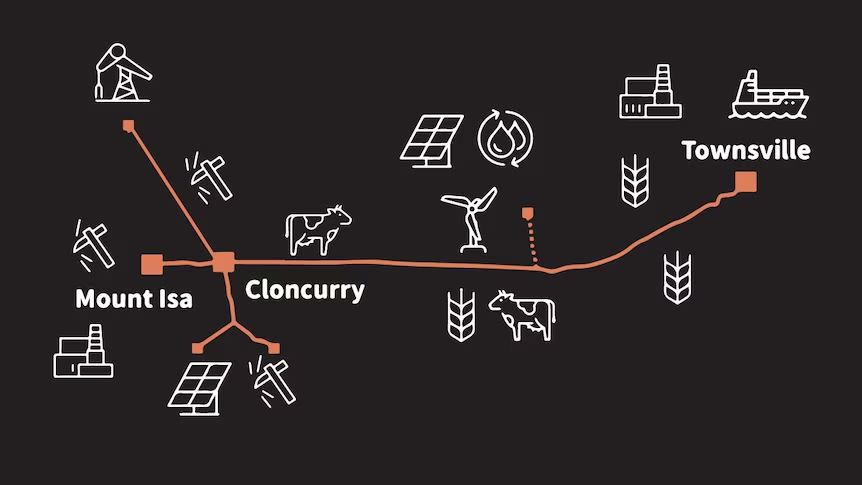
“Where is the public-interest investment to connect Queensland’s world-class North West Minerals Province to the national electricity grid; unlocking more than the $700 billion worth of copper left sitting underground? Why are we forced to wait for the Hughenden irrigation project funding to transform the Mid West’s rich blacksoils into an abundant food bowl and grow our regional towns tenfold, in thriving communities backed by rural and regional industries? And how can we still justify the refusal to build refineries for national fuel security – from the indigenous oil we sell offshore for a fraction of the price that we buy it back as imported petrol, to conversion of our sugar mills into ethanol distilleries to sustainably supply one-fifth of petrol needs with renewable biofuels?
“They’ve dug up our wealth and shut down our industries… and now we’re shocked we can’t stand on our own feet? When the real issue is not whether government has finally recognised the problem, but that it took a global energy supply-chain catastrophe for them even to notice at all.
Extra $44m to pursue Afghanistan war crimes
“And – among a quagmire of devastating outcomes for the Kennedy electorate – we’ve discovered that instead of providing the additional support that is much-need for ex-Defence personnel, an extra $44 million will be given to the Office of the Special Investigator to pursue alleged ‘war crimes’ in Afghanistan.
Mr Katter dubbed intergenerational inequity “just a fancy way of justifying more taxes on money already taxed five times over – a disincentive to save, build and create – while funding more welfare”, in commenting further on headline Budget measures to redress cost-of-living for Australians:
TAX REFORM
Reducing low-income tax thresholds – The Budget is understood to reduce the marginal tax rate from 16-15 per cent for people earning $18,000-$45,000 (to save low-income earners about $5 a week), and 14 per cent in July 2027. “Struggling low-income earners need assistance – however, a tax break this meagre doesn’t even buy a beer, let alone cover the increased costs in groceries and fuel predicted with ongoing global instability.”
Property and Investment – the Budget’s broken promises include:
- Capital gains tax (CGT) discounts: Removing the 50 per cent CGT discount for investment assets to a pre-1999 inflation indexation model (taxed on profit that exceeds inflation) capped at a 30 per cent discount – including pre-1985 CGT assets, held by individuals, trusts and partnerships – to substantially increase the amount of tax paid on capital gains in most circumstances.
- Negative gearing: Removing investment rental property loss offsets against personal income except on new builds – restricted further to only two properties – to fundamentally change investment options for hard-working Australians and risk financial ruin for families with high-mortgaged property portfolios.
- Discretionary trusts: Imposing a 30 per cent tax on distributions (currently tax-free up to $22,500) to adult beneficiaries, to remove ‘income-splitting’ options. Although exemptions exist for primary producers and vulnerable minors, this shifts the goal posts for various family businesses and could lead family-run owner-operators to financial ruin from substantial increases to their tax bill.
“These changes are the nuts and bolts of what Government is doing to address intergenerational inequity and reduce the price of housing. But such fundamental changes should have been taken to an election. Instead, the Prime Minister promised ‘50 times’ that CGT and negative gearing wouldn’t be changed but reneged to improve the Budget bottom line – putting hard-working families and family businesses on the sacrificial financial alter. This Budget was a great opportunity to support families by introducing ‘income-splitting’ so that single-income families could divide their income to reduce individual tax loads, putting them on par with dual-income couples.”

PRODUCTIVITY MEASURES
The Budget was predicted to provide $13 billion to: cut red-tape compliance measures to enable free access to Australian building and construction standards, make permanent the $20,000 instant asset write-off for small businesses to invest in technology, tools and machinery, and offset losses against previous years’ taxable profits. “It is unclear how much of the $13 billion will be spent on reducing compliance and cutting red tape – or how this can even be done when we have such an inflated bureaucracy. In the four years since Labor formed Government, the Australian Federal Public Service has increased by more than 40,000 to total almost 216,000 employees – with a wage bill of $42 billion. If Government does not introduce an immediate policy of non-replacement of non-frontline employees, compliance red-tape will continue to grow – regardless of any catchphrase slogans on ‘streamlining approvals’. And whilst the ‘asset write-off’ and ‘offset for losses’ measures may help small business, it would be better if write-off provisions applied only to Australian-made and owned tech, tools, and machinery to ignite Australia’s manufacturing sector. Australian-made and Australia first.”
AFFORDABLE HOUSING
The Budget is understood to enact ‘planning reform to cut red tape’ (above); adopt modern construction methods; and spend $2 billion on water, roads and sewage infrastructure for 65,000 new homes in the next decade. “Again, without cutting bureaucracy, the ‘streamlining environmental approvals’ slogan seems not worth the back of the envelope it’s written on. Three-quarters or $1.5 billion of the housing infrastructure funding is targeted to our already overcrowded, infrastructure-rich coastal cities; while only $500 million is for the other 99.75 per cent of Australia’s land mass where we have the space, jobs and desperate need for housing support. We need policies for decentralisation, not further urbanisation. Every Australian deserves the great Australian dream of a home with a picket fence out front and enough backyard for a cricket match under a shady gum tree.”
DEFENCE PREPAREDNESS
The Budget is understood to provide $425 billion in next 10 years toward a goal of three per cent of Gross Domestic Product by 2034, to focus on self-reliance and Australia-United Kingdom-United States (AUKUS) partners. This is an increase of $14 billion across the next four years, and $53 billion across the decade. Key spending targets include:
- Naval assets – to accelerate the delivery of surface ships and nuclear submarines;
- Long-range strike – expanding capabilities; and
- Automation – increased spending on uncrewed systems and capabilities.
“For many years, we have emphasised the need to increase Defence spending to fortress Australia from threats to our vast exposed and unpopulated coastline. So, whilst such spending is applauded, this commitment does nothing to shore up the foundations that underpin our forces. Immediate and decisive action is needed to:
- regain control of strategic assets and locations – including our ports, airfields, agricultural lands, electricity supplies and telecommunications;
- provide resources and encouragement to substantially increase the number of combat-ready civilians;
- re-instil throughout Australia, the respect and huge debt of gratitude we should have for current and past Australian Defence Force personnel.
“Without these fundamentals, Australia lends itself to a high degree of vulnerability to those who want to exploit our vast expanse of natural wealth. As history warns, ‘a people without land will look for a land without people’.”

ENERGY AND FUEL
The Budget includes the recent announcement of $10 billion on measures to extend our domestic fuel stockpile, increase supply chain resilience in global chaos, and provide fertiliser security with strategically located fuel reserves. “$10,000 million is a lot for what appear to be offshore solutions to redressing our island nation’s lack of sovereign fuel security – which are a stay of execution for our island nation if global supply chains are blocked. What about increasing the number and capabilities of our oil refineries; converting our sugar mills to make fuel and energy; investing in cheap power generation; introducing, expanding and enforcing an ethanol mandate to reduce the stranglehold of ‘Big Oil’; extending the recently announced reserve resource policy to cover coal and oil; and extending the discount on fuel excise?”
OTHER BUDGET REFORMS
Carbon emissions and electric vehicles – It is understood there is significant pullback in Budget spending on net-zero carbon initiatives – including decreased tax incentives for electric vehicles and renewable energy subsidies.
“Finally, Government has been forced to wake up and realise that a blinkered approach to net-zero is unviable and sending Australia along a fast-track to economic oblivion. However, this rollback seems too little and comes too late to stop the economic pain that future Australians will have to endure, due to successive governments’ ideological mismanagement.”
Research and development incentives – the Budget is understood to provide a significant increase in the cut-off cap for taxation incentives on research and development – from up to $150 million projects, to between $250 million and $300 million projects – plus an extra $387 million for the Commonwealth Scientific and Industrial Research Organisation (CSIRO). “These incentives seem ever-more targeted toward funding junkets and tax dodgers at the big end of town – giving tax offsets to big-business multinationals that remain out-of-reach to Australia’s innovative family run start-ups.”
Meeting workforce demands – the Budget is understood to prioritise skilled migration and increase digital literacy in the workforce. “What about putting Australia and Australians first? We need to encourage the Australian workforce before looking offshore. Government should be focused on increasing the workforce participation of Australian residents.”
National Disability Insurance Scheme rollback – The Budget will save almost $40 billion by significantly tightening NDIS eligibility requirements to slow participant growth toward a goal of reducing participant numbers by 160,000 people by 2030. “Whilst the NDIS has been a game-changer for many people with disabilities and their families, it has become clear the scheme requires significant restructuring to address widespread rorting. However, these measures only look at ‘eligibility’ rorts when what appears to be a far greater issue to be addressed, is the rorting by organisations administering the scheme. It is outrageous that fraudulent businesses have been created with the primary purpose of effectively thieving from, neglecting and defrauding some of the most vulnerable members of our society.”
Seniors’ health insurance – retirees and seniors are likely to be adversely impacted by Budget changes to private health insurance rebates, which will increase out-of-pocket expenses for essential and life-saving medications. “For many years, successive Governments have encouraged Australians to take up private health insurance to take pressure off the public system. With increased out-of-pocket expenses, however, some medicines might become unaffordable, forcing low-income individuals to give up on their private health care and return to the public system.”
Infrastructure (apart from housing) – theBudget spend on infrastructure (apart for housing) is ridiculously low – particularly in regional areas. Big-ticket items already announced include $3800 million for Melbourne Rail (increasing total Federal spend to $6000 million) and $50 million to make the Sydney-Canberra rail trip faster. “The regions hold the key to Australia’s economic future. We have the natural resources – the mineral wealth, the land, the water, the agriculture. Once again, Government is doing nothing to invest in money-generating projects. Where is the money for North Queensland’s Hughenden irrigation project, the Inland Highway and Bruce Highway upgrades (particularly the Gairloch and Seymour river crossings north of Ingham) and Marreba-Cairns Bridle Track Tunnel, or the nation-building CopperString transmission line to connect Mount Isa to the national electricity grid?”
As the world’s rules-based order unravels, the Federal Budget reveals a nation still trying to find quick fixes instead of investing in self-sufficiency for sustainable economic resilience.
“This is a giant missed opportunity to utilise our own natural resources and invest in domestic power plants, refineries and biofuels that future-proof our energy security,” said veteran North Queensland MP Bob Katter.
“More must be done to reserve Australia’s natural resources for domestic use, as the lifeblood for our rural and regional communities to not just survive but thrive. But it’s clear we’re nothing more than a quarry to give away our most vital resources to foreign landlords to add value offshore – and buy back for 10 times the cost – rather than use Australian resources for Australian-owned products that reduce our deadly dependence on imports,” added the Parliamentarian of 51 years, who served as Queensland mines and energy minister in the late-1980s.
With agriculture and mining as the backbone of our nation’s economy and prosperity for 90 per cent of Australians living on less than 0.25 per cent of our land mass, Mr Katter warned “this has led to systematic neglect of wealth-creating regions to focus on votes in the economic-sponge metro hubs.”
“Governments once built dams, railways, power plants and refineries. Now, they build departments and politically convenient urban projects whilst oversighting our economic decline – treating sovereignty as an afterthought, instead of as the foundation to national policy. And so, rather than building, Labor is patching holes from decades of mismanagement by climate change and free market ideologues whilst Australia pays the price for governing ‘by headline’ instead of for the people.”
Mr Katter noted the 2026 Budget ‘talking points’ on housing affordability to reduce ‘intergenerational inequity’ with ‘energy security resilience’ for cost-of-living relief, were unsupported by infrastructure investment in place of “piecemeal reactions to economic shocks, as a repair bill for strategic neglect”.
“Where is the public-interest investment to connect Queensland’s world-class North West Minerals Province to the national electricity grid; unlocking more than the $700 billion worth of copper left sitting underground? Why are we forced to wait for the Hughenden irrigation project funding to transform the Mid West’s rich blacksoils into an abundant food bowl and grow our regional towns tenfold, in thriving communities backed by rural and regional industries? And how can we still justify the refusal to build refineries for national fuel security – from the indigenous oil we sell offshore for a fraction of the price that we buy it back as imported petrol, to conversion of our sugar mills into ethanol distilleries to sustainably supply one-fifth of petrol needs with renewable biofuels?
“They’ve dug up our wealth and shut down our industries… and now we’re shocked we can’t stand on our own feet? When the real issue is not whether government has finally recognised the problem, but that it took a global energy supply-chain catastrophe for them even to notice at all.
“And – among a quagmire of devastating outcomes for the Kennedy electorate – we’ve discovered that instead of providing the additional support that is much-need for ex-Defence personnel, an extra $44 million will be given to the Office of the Special Investigator to pursue alleged ‘war crimes’ in Afghanistan.
Mr Katter dubbed intergenerational inequity “just a fancy way of justifying more taxes on money already taxed five times over – a disincentive to save, build and create – while funding more welfare”, in commenting further on headline Budget measures to redress cost-of-living for Australians:
TAX REFORM
Reducing low-income tax thresholds – The Budget is understood to reduce the marginal tax rate from 16-15 per cent for people earning $18,000-$45,000 (to save low-income earners about $5 a week), and 14 per cent in July 2027. “Struggling low-income earners need assistance – however, a tax break this meagre doesn’t even buy a beer, let alone cover the increased costs in groceries and fuel predicted with ongoing global instability.”
Property and Investment – the Budget’s broken promises include:
- Capital gains tax (CGT) discounts: Removing the 50 per cent CGT discount for investment assets to a pre-1999 inflation indexation model (taxed on profit that exceeds inflation) capped at a 30 per cent discount – including pre-1985 CGT assets, held by individuals, trusts and partnerships – to substantially increase the amount of tax paid on capital gains in most circumstances.
- Negative gearing: Removing investment rental property loss offsets against personal income except on new builds – restricted further to only two properties – to fundamentally change investment options for hard-working Australians and risk financial ruin for families with high-mortgaged property portfolios.
- Discretionary trusts: Imposing a 30 per cent tax on distributions (currently tax-free up to $22,500) to adult beneficiaries, to remove ‘income-splitting’ options. Although exemptions exist for primary producers and vulnerable minors, this shifts the goal posts for various family businesses and could lead family-run owner-operators to financial ruin from substantial increases to their tax bill.
“These changes are the nuts and bolts of what Government is doing to address intergenerational inequity and reduce the price of housing. But such fundamental changes should have been taken to an election. Instead, the Prime Minister promised ‘50 times’ that CGT and negative gearing wouldn’t be changed but reneged to improve the Budget bottom line – putting hard-working families and family businesses on the sacrificial financial alter. This Budget was a great opportunity to support families by introducing ‘income-splitting’ so that single-income families could divide their income to reduce individual tax loads, putting them on par with dual-income couples.”
PRODUCTIVITY MEASURES
The Budget was predicted to provide $13 billion to: cut red-tape compliance measures to enable free access to Australian building and construction standards, make permanent the $20,000 instant asset write-off for small businesses to invest in technology, tools and machinery, and offset losses against previous years’ taxable profits. “It is unclear how much of the $13 billion will be spent on reducing compliance and cutting red tape – or how this can even be done when we have such an inflated bureaucracy. In the four years since Labor formed Government, the Australian Federal Public Service has increased by more than 40,000 to total almost 216,000 employees – with a wage bill of $42 billion. If Government does not introduce an immediate policy of non-replacement of non-frontline employees, compliance red-tape will continue to grow – regardless of any catchphrase slogans on ‘streamlining approvals’. And whilst the ‘asset write-off’ and ‘offset for losses’ measures may help small business, it would be better if write-off provisions applied only to Australian-made and owned tech, tools, and machinery to ignite Australia’s manufacturing sector. Australian-made and Australia first.”
AFFORDABLE HOUSING
The Budget is understood to enact ‘planning reform to cut red tape’ (above); adopt modern construction methods; and spend $2 billion on water, roads and sewage infrastructure for 65,000 new homes in the next decade. “Again, without cutting bureaucracy, the ‘streamlining environmental approvals’ slogan seems not worth the back of the envelope it’s written on. Three-quarters or $1.5 billion of the housing infrastructure funding is targeted to our already overcrowded, infrastructure-rich coastal cities; while only $500 million is for the other 99.75 per cent of Australia’s land mass where we have the space, jobs and desperate need for housing support. We need policies for decentralisation, not further urbanisation. Every Australian deserves the great Australian dream of a home with a picket fence out front and enough backyard for a cricket match under a shady gum tree.”
DEFENCE PREPAREDNESS
The Budget is understood to provide $425 billion in next 10 years toward a goal of three per cent of Gross Domestic Product by 2034, to focus on self-reliance and Australia-United Kingdom-United States (AUKUS) partners. This is an increase of $14 billion across the next four years, and $53 billion across the decade. Key spending targets include:
- Naval assets – to accelerate the delivery of surface ships and nuclear submarines;
- Long-range strike – expanding capabilities; and
- Automation – increased spending on uncrewed systems and capabilities.
“For many years, we have emphasised the need to increase Defence spending to fortress Australia from threats to our vast exposed and unpopulated coastline. So, whilst such spending is applauded, this commitment does nothing to shore up the foundations that underpin our forces. Immediate and decisive action is needed to:
- regain control of strategic assets and locations – including our ports, airfields, agricultural lands, electricity supplies and telecommunications;
- provide resources and encouragement to substantially increase the number of combat-ready civilians;
- re-instil throughout Australia, the respect and huge debt of gratitude we should have for current and past Australian Defence Force personnel.
“Without these fundamentals, Australia lends itself to a high degree of vulnerability to those who want to exploit our vast expanse of natural wealth. As history warns, ‘a people without land will look for a land without people’.”
ENERGY AND FUEL
The Budget includes the recent announcement of $10 billion on measures to extend our domestic fuel stockpile, increase supply chain resilience in global chaos, and provide fertiliser security with strategically located fuel reserves. “$10,000 million is a lot for what appear to be offshore solutions to redressing our island nation’s lack of sovereign fuel security – which are a stay of execution for our island nation if global supply chains are blocked. What about increasing the number and capabilities of our oil refineries; converting our sugar mills to make fuel and energy; investing in cheap power generation; introducing, expanding and enforcing an ethanol mandate to reduce the stranglehold of ‘Big Oil’; extending the recently announced reserve resource policy to cover coal and oil; and extending the discount on fuel excise?”
OTHER BUDGET REFORMS
Carbon emissions and electric vehicles – It is understood there is significant pullback in Budget spending on net-zero carbon initiatives – including decreased tax incentives for electric vehicles and renewable energy subsidies.
“Finally, Government has been forced to wake up and realise that a blinkered approach to net-zero is unviable and sending Australia along a fast-track to economic oblivion. However, this rollback seems too little and comes too late to stop the economic pain that future Australians will have to endure, due to successive governments’ ideological mismanagement.”
Research and development incentives – the Budget is understood to provide a significant increase in the cut-off cap for taxation incentives on research and development – from up to $150 million projects, to between $250 million and $300 million projects – plus an extra $387 million for the Commonwealth Scientific and Industrial Research Organisation (CSIRO). “These incentives seem ever-more targeted toward funding junkets and tax dodgers at the big end of town – giving tax offsets to big-business multinationals that remain out-of-reach to Australia’s innovative family run start-ups.”
Meeting workforce demands – the Budget is understood to prioritise skilled migration and increase digital literacy in the workforce. “What about putting Australia and Australians first? We need to encourage the Australian workforce before looking offshore. Government should be focused on increasing the workforce participation of Australian residents.”

$40 billion from those really in need
National Disability Insurance Scheme rollback – The Budget will save almost $40 billion by significantly tightening NDIS eligibility requirements to slow participant growth toward a goal of reducing participant numbers by 160,000 people by 2030. “Whilst the NDIS has been a game-changer for many people with disabilities and their families, it has become clear the scheme requires significant restructuring to address widespread rorting. However, these measures only look at ‘eligibility’ rorts when what appears to be a far greater issue to be addressed, is the rorting by organisations administering the scheme. It is outrageous that fraudulent businesses have been created with the primary purpose of effectively thieving from, neglecting and defrauding some of the most vulnerable members of our society.”
Seniors’ health insurance – retirees and seniors are likely to be adversely impacted by Budget changes to private health insurance rebates, which will increase out-of-pocket expenses for essential and life-saving medications. “For many years, successive Governments have encouraged Australians to take up private health insurance to take pressure off the public system. With increased out-of-pocket expenses, however, some medicines might become unaffordable, forcing low-income individuals to give up on their private health care and return to the public system.”
Infrastructure (apart from housing) – theBudget spend on infrastructure (apart for housing) is ridiculously low – particularly in regional areas. Big-ticket items already announced include $3800 million for Melbourne Rail (increasing total Federal spend to $6000 million) and $50 million to make the Sydney-Canberra rail trip faster. “The regions hold the key to Australia’s economic future. We have the natural resources – the mineral wealth, the land, the water, the agriculture. Once again, Government is doing nothing to invest in money-generating projects. Where is the money for North Queensland’s Hughenden irrigation project, the Inland Highway and Bruce Highway upgrades (particularly the Gairloch and Seymour river crossings north of Ingham) and Marreba-Cairns Bridle Track Tunnel, or the nation-building CopperString transmission line to connect Mount Isa to the national electricity grid?”
The goyim should be taxed harder. Govern me harder daddy!
“Australia nothing more than a quarry to give away our most vital resources to foreign landlords”
<<<<<<<<<<<<<<<<<<<<<<<<<<<<<<<<<<<<<<<<
Well there’s no getting round the fact that that was the originating purpose
And that, unlike the inhabitants of the North American colonies, only a handful of settlers were prepared to put their lives on the line via declaring independence
If a woman walked into the toilet of Trump Tower and gave birth. Does this now mean, that Trump Tower and its contents automatically belong to the child as his birthright?. Of course not.
.
Likewise, when certain Americans legally bought a piece of woodland and passed the land and deeds to their descendants. Does this also mean, that because someone was born in New York City today, this automatically makes them an owner of the land and its income? Of course not.
.
I was born in a hospital on somebody else’s estate. This does not give me any right to claim ownership of the land and its revenue stream. Somebody legally bought the land centuries ago, developed it, passed it to their descendants, or sold it to new owners.
.
Just because you were born somewhere, doesn’t mean you own the land, or its revenue. If your ancestors names ain’t on the land deeds, it ain’t yours.
.
Most people are squatters.
The ignoring of every instance of neglect of profitable trading of Australia’s natural resources is part of the globalist NWO agenda of leaving it all in the ground for when they move in after being invited to takeover all governing of Australia.
They have to break our backs and minds and our economy and religious basis, and replace it all with the globalist tactics you see in great Britain and Europe, by letting the Islamic Horde takeover,and cripple everything that has worked in the past. Then they foolishly think they can take it back off these evil minded brainwashed killers, and after reducing our population to just a few worthy slaves, they will rule over all that is left without any compassion for anyone outside of their very tiny circle of politics.
This is what you all voted for when you voted Uniparty …Liberal/Labour/Greens/Teals/Nationals … all these parties have been voting in parliaments for your demise.
AND … they manipulate all the other votes with PREFERENCES at elections.
TO WIN THIS WAR OF THE AUSTRALIAN COMMUNIST TAKEOVER, YOU HAVE TO MOVE OUTSIDE OF THE BOX.
One would really awaken to the scam if this article is read in conjunction with the previous Cairns News article on Frederic Bastiat
[…] Source link […]