


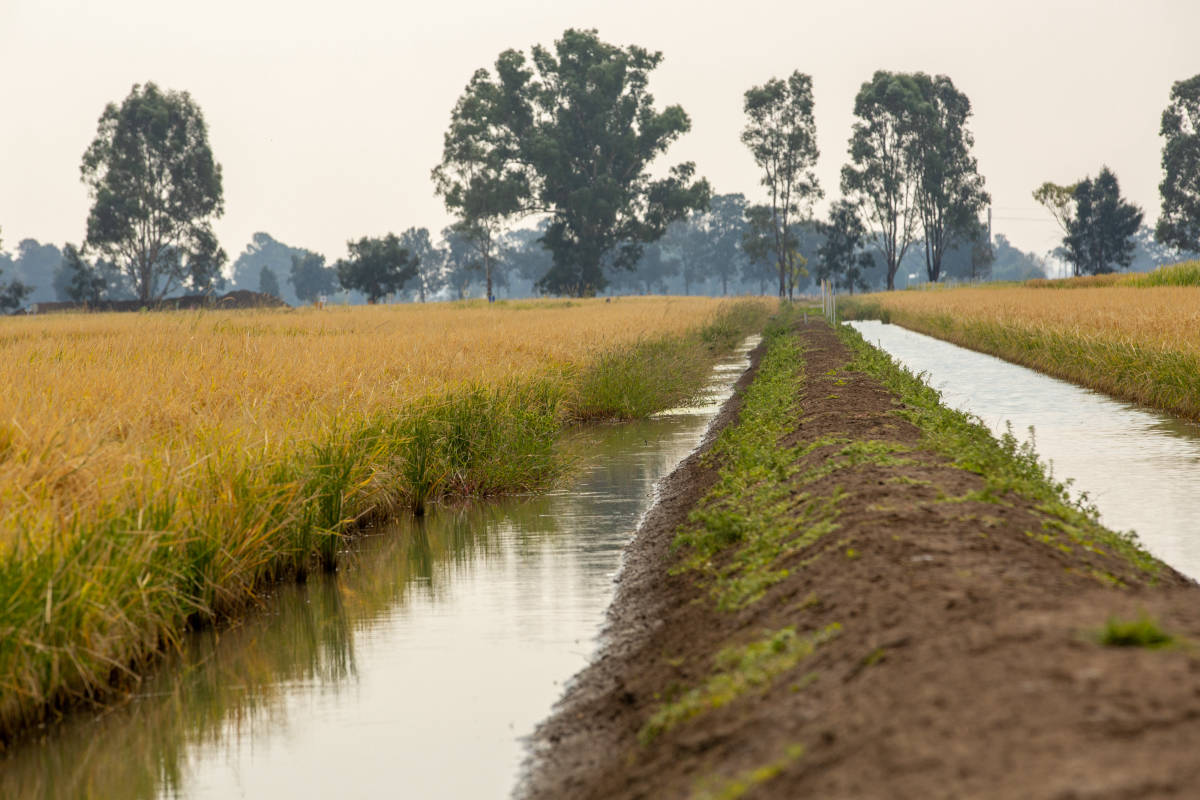
Federal Member for Farrer David Farley is warning of dire consequences for communities in the Murray Irrigation district of his electorate if Ministers do not put pen to paper to work with industry.
It comes as the rice planting window closes in exactly ten days from October 18.
Mr Farley warns if water held back for environmental flow is not injected into the delivery for productive irrigation within this micro-window, the entire season’s production capacity will drop to nothing.
“The ground around Deniliquin is locked into the starting gate. The paddocks are worked up, the bays are laid out, and the seed is booked. The microeconomics have been run, temporary water prices add up, the private capital is fully exposed, and the labour pool is waiting. The entire physical supply chain is primed,” Mr Farley said.
“But one variable is missing: a signature from three specific nodes in the state and federal executive framework.”
He said pen to paper is required by Federal Environment and Water Minister Murray Watt, NSW Environment Minister Penny Sharpe, and NSW Water Minister Rose Jackson.
“Mother Nature operates an absolute demographic and biological clock,” Mr Farley said, who has spent a career in agribusiness spanning some 50 years.
“That means it does not issue extensions for ongoing departmental reviews, and it does not reopen for parliamentary consultation.
“We are talking about a forfeited output of 80,000 to 110,000 tonnes of paddy rice under baseline conditions, scaling up to 150,000 tonnes under peak, industry-leading water-efficiency matrices,” Mr Farley said.
“This is sovereign food security—Australian commodity volume destined for domestic supermarket shelves and high-yield export markets—left completely unproduced.”
Mr Farley warns the immediate cost to the human geography of the Edward River Shire is the deletion of 230 to 270 structural jobs within a fortnight.
“That breaks down cleanly: 60 to 80 primary production jobs on-farm, 80 to 90 inside the local service economy, and 90 to 100 industrial processing jobs at the mill,” he said.
“This is a massive demographic shockwave to a regional hub like Deniliquin.
“It dictates whether a local mechanic retains an apprentice, small commercial storefronts can remain viable, and whether young families permanently exit the regional pool for capital cities.”
Mr Farley brought both state and federal leadership into question, noting that if the policy is not punishing a high-efficiency food-producing basin or systematically starving an industry until it can be written off as structurally unviable—then Ministers Watt, Sharpe and Jackson need to land in Deniliquin and articulate the baseline economic rationale.
“Why does 1.77 per cent of stored water need to remain inert behind a dam wall while a regional engine room is turned off?” Mr Farley said.
“Here is an isolated asset capable of generating real-time payroll, corporate tax, and regional economic velocity within weeks, yet economic ministers remain completely silent.
“If the Prime Minister and the Premier genuinely govern for the geographic regions as they claim, the directive to their respective water portfolios should be immediate and absolute,” he said.
Mr Farley warns time is running out for leaders to act.
“In just days, the administrative window will slam shut, and the subsequent reviews, ministerial press releases, and community consultations will mean absolutely nothing,” he said.
“The paddocks will stay dry, the mill machinery will remain silent, and the regional electorate will remember precisely who possessed the administrative leverage to act and choose paralysis instead.”
Why is Australia growing rice? It requires too much water, just like Cotton.