



By NATUREQ
Digital Creator
FOR almost two years, people on Kangaroo Island joked about the “yeti” that lived out along an old fire trail. A big grey shape, seen for a second and then gone into the scrub. When they finally caught it and cut away more than thirty kilos of wool, a small yellow tag in its ear made a farmer sit down on the shearing shed floor.
Kirsty Wade is 44. She drives the school bus on the western end of the island and her route takes her along a dirt road that runs beside the bush. In January 2020, that bush burned.
The fires that summer took about half the island. Kirsty’s family lost a shed and most of their fences. Some families lost everything.
Five years on, the bush has grown back thick and green between the black trunks. That’s where she first saw it, in the winter of 2023.
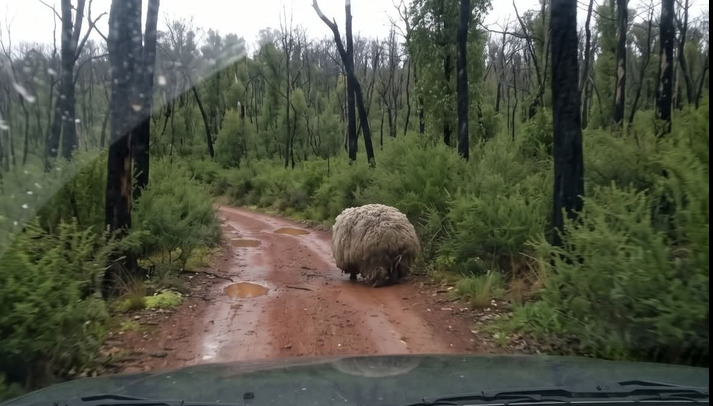
On the way home after the morning run, something was standing on the fire trail ahead of her. Grey, round, about the size of a small car tyre stood on its end.
She slowed down. It turned, and ran into the scrub.”I honestly didn’t know what I’d seen,” she says.
Over the next months, she saw it again. Four times, maybe five. Always on the same stretch. Always gone before she could get her phone out.
When she finally got a photo, it was blurry, taken through the windscreen. She posted it on the island’s community Facebook page.
The comments were mostly jokes.
“That’s the KI yeti.” “Bigfoot’s on holiday.”
One older farmer wrote something different. “That’s a sheep that’s never been shorn. Poor thing.”
Kirsty looked at the photo again. He was right. There was a face in there somewhere, buried in wool. Nobody on the page said it was theirs.
She rang a couple of farms near the trail. Nobody was missing a sheep. Nobody had been missing a single sheep in years, they said. Not since the fire.
She tried leaving hay out. It went untouched. She tried walking in with her son. They found a path through the scrub, and a dent in the ground under a fallen tree where something heavy had been lying. They never got close.
In May 2025, she rang a shearer she knew from the pub, Dean.
He listened, then said what the older farmer had said. Merino sheep don’t drop their wool. It keeps growing every year until someone cuts it. If this one had been out there since the fire, it was carrying five years of fleece.
“In the summer heat, that can kill them,” he told her. “She might not have another one in her.”
On Saturday the 24th, Kirsty, her son Liam, Dean and two neighbours walked into the scrub with a long net and a bucket of grain. It took most of the morning.
In the end, she didn’t run very far. She couldn’t. The wool hung so low it dragged on the ground, and so thick over her eyes that she couldn’t see where she was going. She walked into the net and just stood there, breathing hard.
It took four of them to lift her onto the back of the ute.
Dean sheared her in Kirsty’s neighbour’s shed that afternoon. It took him nearly an hour.
The fleece came off in one huge grey piece, full of twigs, burrs and burnt bark. They weighed it on the bathroom scales, a bit at a time – thirty-one kilos.
Underneath was a small, thin, white ewe, shaking on the boards. She looked half the size she had been.
And when Dean cleared the wool away from her face, there was a tag in her left ear. Faded yellow, chewed at the edge, but you could still read the printed code.
Every sheep farm in Australia has its own code. Liam looked it up on his phone. Then the room went quiet.
The code belonged to a farm about eight kilometres from the trail. A farm that had lost almost all of its sheep in the January fire.
Kirsty knew the farmer, Graham. Everybody did.
Graham is 61. He and his wife, Lyn, have farmed there for over thirty years.
On the 3rd of January 2020, the fire came through their back paddocks in less than an hour. More than two thousand sheep were caught against the fences.
For the next three days, Graham and his neighbours went paddock to paddock with rifles, putting down the ones that were too badly burned to save.
He doesn’t talk about those days much.
Afterwards, the family restocked with a smaller flock. But Lyn says he never really went back into the far paddocks after that. He let the neighbours do the fencing out there.
Kirsty rang him that evening. He didn’t say much. He said he’d come in the morning.
On Sunday, he drove over with Lyn.
He walked into the shed and looked at the thin white ewe in the pen, next to the mountain of wool on the floor.
He leaned over and turned the tag in his fingers. He read it twice.
Then he sat down on the shed floor, his back against the wall, and put his hand on her neck.
“He didn’t say anything for a long time,” Kirsty says. “Neither did any of us.”
The island vet checked her over. She was underweight and her teeth were worn, but she was healthy. She must have found a gully with water, the vet said, and somehow kept out of the worst of the flames. Sheep do survive like that, now and then. Just not many.
She went home with Graham and Lyn that day.
She lives in the house paddock now, with two pet lambs the grandkids are raising. They tried to give her a proper name. It didn’t stick. Everyone still calls her Yeti.
Graham shears her himself now, every spring.
“I buried everything else from that paddock,” he says. “She’s the one I got to bring home.”
sheep
We had an old ram 🐏 like this, that we found in the shrub. It looked like it was swimming when he was walking, until he just couldn’t anymore & a neighbour had a go at him, but half way through, the blade disappeared. A hunter came by with his metal detector, but to no avail… Neighbour thought that he should have another blade at home & said that he’ll look & come back tomorrow. I had a bad feeling about that & sure enough; during the night, the pigs got to him. It would have been so nice to see him free of that wool.
Yes a nice story well told and another welcome break from toxic politics and hopeless Labor.
Commenter Thompson
I wonder if there is a wild sheep still in existence anywhere.
I have a “yeti” sheep anecdote from when I was young and on a farm for a short while, the lads discovered it and within a matter of minutes it was hanging up by its back legs with its throat cut.
I wonder how wild sheep copped before they were domesticated for their wool ; I expect they all looked like Yeti and staggered around blinded by their wool that covered their eyes like I have seen on sheep stations I have worked on .
What a miracle – I love stories that have happy endings!! Long live Yeti.