


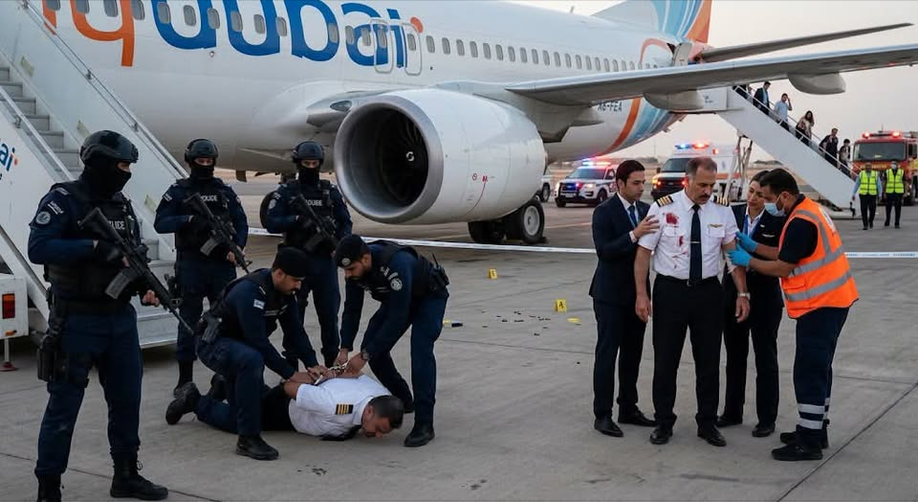

A PERSON claiming to be a 737 pilot has posted a series of flight aerodynamic facts on social media raising serious questions about the flight narrative around the Fly Dubai hijacking.
The hijacking could well be a false flag operation, but we cannot be certain at this stage. It came complete with multiple alleged heroism accounts which worked brilliantly in the immediate aftermath for Israeli PM Benjamin Netanyahu, who is facing re-election. But it wasn’t long before conflicting facts started to emerge.
A video posted online by one debunker shows passengers on the alleged flight holding seats that are shaking violently, but with no oxygen masks dropping down as they would in any emergency. However we are told that masks are released manually.
Another video shows seat back screens all blank in mid flight, then square seat backs in one scene and rounded seat backs in another, as well as a different ceiling and overhead storage structures.
And yet another video shows passengers with phones allegedly walking around in the plane after it supposedly recovered from the near supersonic, catastrophic 14,000ft plunge, supposedly pulled off by an Israeli plumber who made his way into the cabin and remembered how to control the jet after watching episodes of Air Disasters. Yeah right.
“I fly this exact jet and I ran all the numbers. I’ll go with “things that didn’t happen” for $1000 Alex,” the anonymous pilot posted in response to a popular line spoken in the TV gameshow Jeopardy!, in which contestants get to choose a category and the amount of points that category will be worth. So they say “I’ll take ‘Current Affairs’ for 400 please Alex!”
“These are pure physics numbers that can’t be disputed unless maybe this jet was flying on the moon!”
The pilot goes on to explain that even with the engines at flight idle, the aircraft would accelerate rapidly past its structural limits, entering the transonic or supersonic regime and reaching speeds well over Mach 1.0 (approx. 700+ knots/1200 feet per second).
He points out that the speed increase would be catastrophic because even at idle, jet airliners are highly aerodynamic and have very low drag, so when pitching down 30 degrees or more, gravity acts as a massive accelerator that easily overcomes idle thrust and aerodynamic drag.
This would produce catastrophic structural overspeed and in a theoretical zero-drag environment, converting 14,000 feet of potential energy directly into kinetic energy would push the aircraft to 1,209 feet per second (Mach 1.15–1.20).
“In reality, even with maximum aerodynamic drag factored in, a commercial airliner cannot dissipate that much gravitational energy. The speed would vastly exceed 𝑉𝑀𝑂 /𝑀𝑀𝑂 (Maximum Operating Limit Speed, typically around Mach 0.82 to 0.89),” the pilot notes.
The physical consequences of a commercial airliner experiencing these figures would face severe aerodynamic phenomena:
Mach buffet and control loss would be experienced as the plane breached Mach 0.9+, with shockwaves forming over the wings, causing extreme buffeting, loss of elevator effectiveness (shock stall), and a phenomenon known as “mach tuck,” which forces the nose down even further.
Structural failure would then set in due to extreme dynamic pressure (Q) at lower altitudes combined with high speeds, which would likely rip apart control surfaces (ailerons, elevators), the tail section, or the wings before the 30 seconds concluded.
At 30,000 feet, Mach 0.77 equates to a true airspeed of roughly 765 feet per second (453 knots) and to redirect that forward momentum downward into a 35° dive required a rapid rotation of the flight path vector.
A three-second rapid push-over requires a sustained load of approximately -3.8 G.A and a two-second violent push-over requires a sustained load of approx. -6.3 G.
What this means: Commercial airliners are typically certified to withstand a maximum of -1.0 G in a clean configuration. A push-over of -3.8 G to -6.3 G would instantly rip the engines off their wing pylons, cause catastrophic structural failure of the main wing spars, and immediately pin anyone not tightly buckled to the ceiling with crushing force.
To exit the dive, by the time the aircraft reached the bottom of a 14,000-foot plunge (now at 16,000 feet), gravity has accelerated the jet to near-supersonic or supersonic speeds—roughly 1,100 feet per second (approx. Mach 1.05 or 650+ knots calibrated airspeed).
Attempting to change the direction of an object moving that fast back to level flight requires immense centripetal force: A four-second pull-out requires a sustained load of approx. +6.2 G. A three-second pull-out requires a sustained load of approx. +8.0 G.
Commercial airliners are structurally certified for a maximum positive load of +2.5 G and pulling +6 G to +8 G at supersonic speeds at 16,000 feet, where the air is much denser than at cruise altitude, would subject the airframe to extreme aerodynamic forces.
The wings would violently snap upward and separate from the fuselage long before the plane leveled.
re: “a false flag geared toward re-possessing the patch of dirt on which the birth,ministry, death and resurrection of Christ took place”
.
The “Crusaders” never forgave the Canaanites, the Hittites, the Phalestines, the Samaritans and other Amalek for living in the Promised Land before they themselves set foot into it. And they still don’t!
re: “Why would Bibi a day later have a photo op with an unwashed hero plumber sporting the same blood soaked tee shirt and jeans?”
.
Becoz d plummer ment to handwash d shrt but forgot becoz him and bibi woz too bisy with d handwringing?
Why would Bibi a day later have a photo op with an unwashed hero plumber sporting the same blood soaked tee shirt and jeans?
.
Was it a shitey habit from the plumber or are geopolitics at play?
.
Friendly Israeli hero saves Indian from Omani.
.
Archaeology digs have verified Indian-Omani trade dating back to around 300 BC.
.
British occupied Bombay controlled Oman for the British Empire.
.
Oman has over 500,000 Indian nationals living there.
.
Oman is said to be neutral in the ongoing U.S.-Israeli verses Iran conflict.
.
Is Israel driving a special strategic wedge between Oman and India? SLAVE-MEDIA’s narrative paints a vivid influential picture.
.
Modi has been encountering flak at home from his silence on the ongoing genocide in Gaza; a partner in crime from Israel’s Ebert Systems-India’s Adani Defence drones buzzing Gaza and Israeli-Indian manufactured Spike missiles taping Gaza; Adani purchasing the Port of Haifa, base for Israel’s submarine fleet.
.
The business connections are many.
.
https://ddnews.gov.in/en/india-israel-sign-16-mous-pm-modi-and-pm-netanyahu-announce-special-strategic-partnership/
.
The world is full of philosophies and theories that push a lie by way of presenting it within an ELEMENT of truth.
The hit of the hour being the claim that anything that appears to favour the existence of Israel as a nation is a cooked up Jew-plot
<<<<<<<<<<<<<
Hence the belief that the Holocaust was a false flag geared toward re-possessing the patch of dirt on which the birth,ministry, death and resurrection of Christ took place, the land from which they were expelled under the command of Titus In 70 A.D.per a failed rebellion against the respective Roman occupation
<<<<<<<<<<<<
WHEREAS anyone who’s familiar with the biblical narrative is well aware that BOTH advents were prophesied circa 1407 BC as being the direct consequence of spiritual rebellion:
https://biblehub.com/deuteronomy/28-15.htm
https://biblehub.com/deuteronomy/28-25.htm
Which of course means that any attempt to negate either of them, or any subsequent curse or blessing off as mere man-made manoeuvring amounts to a denial of where mankind as a whole is actually heading
The Commie/leftist nature of anti-Zionism/anti-Israel affirmed by this attempt to prop it up with a series of self-hater celebrity quotes:
https://www.stopwar.org.uk/article/from-albert-einstein-to-noam-chomsky-famous-jews-who-have-opposed-israel/
Oh dear! It doesn’t matter what’s what. It’s yet another tragi-porn event for us to identify with, to believe in and to fear. We’ve had so many ‘confusing’ fear-porn events since 911 you’ve got to wonder what makes sense these days and who’s keeping an eye on the truth. Trust our truth keepers? Sure can!
“It’s all theatre”
Wars are just engineering projects for the super-capitalists and they have a number of objectives. Max Igan is saying they are bombing the areas of Teh’ran where they are rebuilding for “smart cities” and there is a smart cities expo happening there 31 Oct – 2 Nov that’s Hallowe’en if you want to remember. Obviously Rockerfellas likes to jack the price of petrol up and Trump has to be the scapegoat for it all.
I already catalogued a few weeks ago that every major “US vs another nation” war since Japan involved the BIS getting in to a country, that includes Korea, Vietnam, Iraq, all of them some sizeable incursion of the BIS and that is it’s stated business anyway, and founding constitution, they pretend they are settling the war reparations then they take over with central bank and start running up debt.
They pretend the war created the need for the BIS, but why is it in Basel ( German: Baßel ), why is is shaped like the tower of Babel, why did BISmark unify Germany from Holy Roman Empire to nation state then send all the loot down to Baßel, why why why. I guess all the caves in Zurich were already stuffed full of gold.
Well here’s a good video that came up when I was looking at Robert Sepehr all about the Zionists and should clear a few things up for the joo obsessives [ https://www.youtube.com/watch?v=ywP_EvNbvQk ]
I notice a whinge or two about long comments, nobody is forcing anyone to read long comments, if you have a short attention span paerhaps you are just not suited to thinking, there are sitcoms for you with one-liners, they go for 10 minutes between ad breaks, all one liners.
I think the short attention span is being artificially cultivated, just like boredom is cultivated in the education system.
I’m surprised that Arsen Ostrovsky wasn’t involved.
The more I look at that photo of a pilot standing with 2 people dressed in black holding on to him and a person dressed in that work clothing with orange vest it looks artificial ; why would medical aid be administered on the tarmac by that person ?
The bigger the lie the more childish the story the bigger the lie.
.
Distracting from real events,
Trump’s shadow:
https://x.com/adamemedia/status/2106574666424807789?ref_src=twsrc%5Etfw%7Ctwcamp%5Etweetembed%7Ctwterm%5E2106574666424807789%7Ctwgr%5Edf527fbd7429311e19634d031d297292ace89633%7Ctwcon%5Es1_&ref_url=https%3A%2F%2Fthepeoplesvoice.tv%2Fepstein-whistleblower-found-dead-exposing-howard-lutnicks-elite-pedophile-ring%2F
.
The healthiest children in America the Amish families being force coerced by massive fines to vaccinate their children.
.
Blood sucker’s graveyard-song Patient Zero goes live 6 yrs. 6 mths. 6 days after U.S. CoV lockdowns, the same day the plague escaped the Russian Anti-Plague Institute’s bio lab; seven days later making it to number one the day the first lab scientist died October 2, 2026.
.
Police in The U.K. use signal blockers to interfere with live broadcasts by plebes of immigrants being smuggled into a port in the dead of night.
.
.
Genocidal duo Trump and Mileikowsky are on the election trail, Trump telling his audience that Iran bombing Los Angeles is a small price to pay invokingrapturous applause from the brain dead audience.
Unfortunately, these days if it’s mainstream on a screen and not bs it ain’t believable. Actors on stage, many with uni degrees for legitimacy, reading the scribe compromised with good pay for life as long as they don’t go against the grain. If they do career is finished or worse. Puppet masters are never seen, puppets on all bases loaded.
Bitten apple in every hand leading to temptation with gadgets made by aliens here a long time.
If ever stung by a viper you know the score. Saying that there are good folk in all creeds and colours.
If Bondi was a similar psyop its proof the chosen here have our MSMs sewn up so tightly that only their narratives are ever allowed to air. It worked for the Global mRNA cattle cull, it works for hiding Gaza war crimes and every other hot spot they create. To get away with all of their crimes and subversions they must be running the show here just about. They have colonised Oz making extreme wealth just like the Brits taken the place over to remove us all, right now! No one in Oz has even compiled a list of their interests here to boycott unlike the rest of the civilised world, OzZog Is real
Oh good here we go. As soon as I saw Bibi being sanitised on TV I thought the same, the crowd scenes in the plane with clapping etc, no doubt “accidentally used from file video”. Who is the worst, Bibi with his scorched earth genocide or Putin v Zelenskyy slowly destroying each others assets and human resources in tit for tat fashion. Those Ukrainians who didn’t run away must be so dum they deserve to die. Why would anyone do anything Zelenskyy told ??? It’s a mystery wrapped in a scam inside a complete fraud.
The zionazis have certainly excelled themselves with this absolutely atrocious, glaringly obvious, bullshit fairy tale, false flag! Didn’t they even consider that we would see through all the lies and the absolutely improbable scenario surrounding their bunch of crap farce?! This lie even outdoes the story about the October 7 stand down!!
I want to know how occupied Palestine’s newest sexy superhero plumber got his pipe cutter through security.
.
It’s no longer the baker or milkman that working men have to worry about, plumbers with plungers will be in demand.
.
https://nypost.com/2026/10/03/world-news/hot-passenger-from-hijacked-flydubai-flight-goes-from-everyday-plumber-to-hero-sex-symbol/
The comments I make are on evidence I have read : The injured pilot had head injuries after getting whacked with a hammer designed to break glass and then the other pilot smashed instruments that would render the plane inoperable ; It was reported in the media that passengers forced their way through the locked cockpit door and another story explains how the injured pilot managed to open that same door .
A photo of the pilot who went troppo shows a thinner younger looking face than the person held by Police in the above photo ; Where are photo’s splashed across the media showing what the highjacker looked like after he was arrested by police ?I would like to read the computer readout of the black box to believe the official narrative .