


WE don’t expect air safety commentators to come out screaming “false flag” as details of the Fly Dubai “hijacking” incident come to light.
But air safety experts are stunned by the claimed trajectory of the hijacked Fly Dubai jet, which some anonymous information posted online suggests was catastrophic and would have destroyed the aircraft.
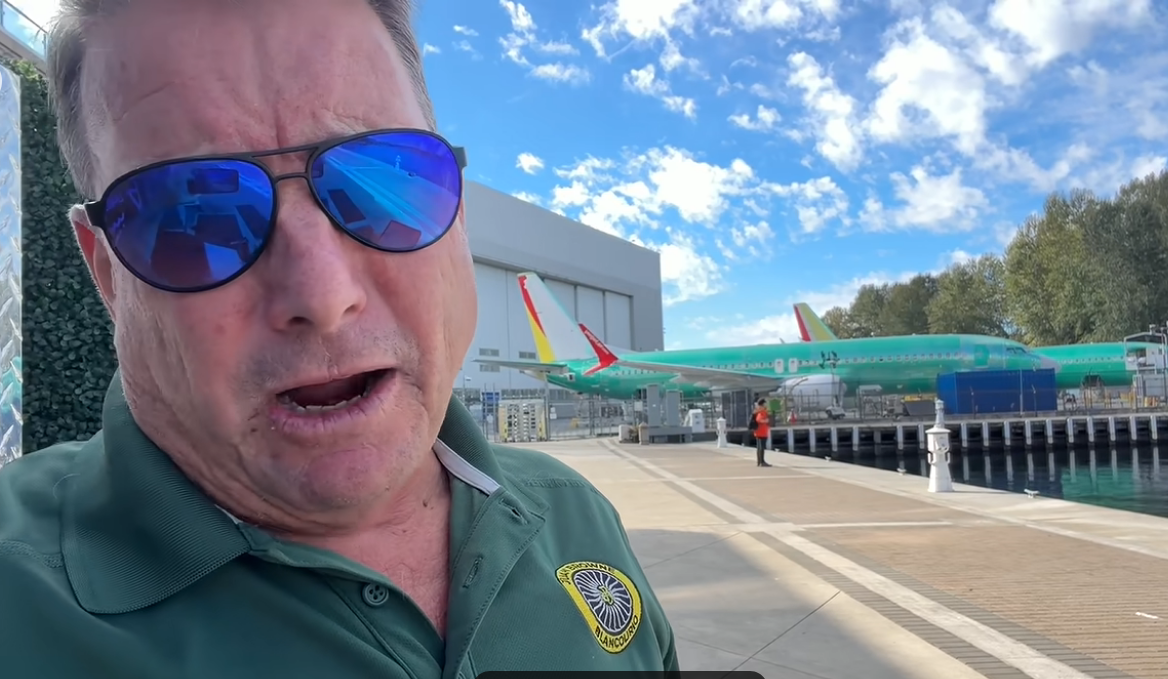
Our video features some commentary from the Renton airport (in Washington state) by Juan Brown, who was attending a Foundation for Aviation Safety Conference where they produce and test the 737 Max aircraft.
Brown says the jet in the alleged September 30 hijacking was a 737 Max 8 which suffered some damage to the rudder, which he suspects was due to “flutter” (a minor aerodynamic disturbance that can turn into a violent, destructive feedback loop), as the aircraft was exposed to some very extreme flight loads as a result of this incident.
“And we’ll get hopefully … data recorder information to see exactly what the airframe was subjected to. But they’re very lucky that they saved the airframe at all,” he says.
The story goes that the 737-8 took off from Dubai, was headed for Tel Aviv when the captain was attacked by the co-pilot wielding the cabin emergency axe at an altitude of 34,000ft, causing the aircraft to plunge to around 14 or 15,000ft in about 30 seconds – a dive that resulted in a rate of descent nearly 28,000 ft per minute.
“Just an incredible rate of descent,” said Brown. “All we have at this point is ground speed information. We don’t have any airspeed indication at this time, what limits were exceeded on this airplane.
“But fortunately, the captain was able to, without getting into security information about how the cockpit doors work, the captain who was being attacked was able to open the cockpit door.
“Once the cockpit door was opened, passengers were able to ascertain the situation and get the sattacking first officer off out of the cockpit and one of the passengers apparently was able to yard back the control yolk and arrest the descent rate of the aircraft.”
He said some “dead-heading” (off duty) crew members were then able to take control of the aircraft and guide it to an airport in Saudi Arabia after “squawking a 7500” emergency code.
“So not a lot to add to that report other than what you’ve already seen or heard on the news. But what’s interesting is that the they didn’t lose the airframe despite the extreme dive and air speed and G (force) loading that that aircraft was subjected to.
“We just don’t know what it what those numbers are at this time. But the rudder was damaged on it. I’m sure the rudder damage was a result of the incident. It obviously caused the dive or the incident. It was a struggle in the cockpit … and that is a honeycomb or composite structure, the rudder itself.
“So it’ll be interesting to see how that played out. But overall, the fact that the aircraft held together completely is a testament to the strength overall strength of the design.”
Air safety experts will be keenly awaiting the data from Fly Dubai to see how a Boeing 737 Max 8 “miraculously” survived a catastrophic mid-air plunge.
Should the narrative somehow survive, which it most likely will, Boeing executives will be greatly buoyed about how their controversial Max 8 survived stresses way beyond the norm.
A Lion Air Flight 610 Max 8 crashed on October 29, 2018, in the Java Sea, Indonesia, resulting in 189 fatalities. Another Max 8, Ethiopian Airlines Flight 302, crashed on March 10, 2019, near Bishoftu, Ethiopia, resulting in 157 fatalities.
Both accidents were linked to issues with the Maneuvering Characteristics Augmentation System (MCAS), a flight control feature, which led to a worldwide grounding of the 737 MAX fleet.
Other incidents involving the broader 737 MAX family, included the Alaska Airlines MAX 9 door-plug blowout in 2024, which involved different technical failings.