



KIWI “blob” voters who think the choice is only between red (Labour) and blue (Nationals) came out again to do what they normally do, but in reduced numbers.
Under the MMP system they have two votes, one for the party of their choice and one for an electorate candidate. Last weekend they split the party vote about equally between red and blue, but late yesterday it looked as if PM Christopher Luxon’s Nationals on a party vote of 30.81% were edging ahead of Labor on 29.99%..
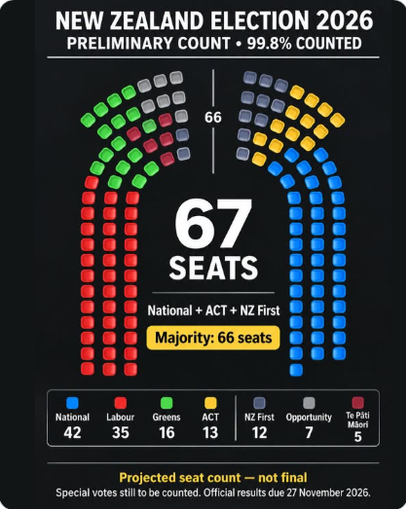
The Nationals so far have a one-seat majority (67 seats) with their coalition partners, the nationalist New Zealand First and the libertarian ACT Party, who since the last election have had limited success steering Luxon’s Nationals away from their woke tendencies such as standing by the Paris Accord climate scam.
ACT and NZ First added about six percentage points to their tallies from 2023, picking up a few extra seats for a total of 25, compared to the Nationals 42.
The latter lost four of their most senior MPs – including its exceptionally woke deputy leader Nicola Willis.
But tragically for the New Zealand economy and political commonsense, this time the one minor party that threatens to hold the balance of power is the so-called “centrist” Opportunity Party that insists its coalition partner must “recommit to Paris Agreement obligations and protect the independence of the Climate Change Commission”.
These people are not “centrists” by any measure, they’re just rebranded Labor-Greens, much like Australia’s Teals, who tout policies allegedly from the moral high ground, aimed at curbing government power and corruption.
The party also proposes the hare-brained idea of appointing “a Future Generations Commissioner to hold governments accountable for long-term decisions regarding climate, AI, and national resilience”.
This is why the country’s notoriously leftist media has been banging the drum for the party as the election decider. International media has also chimed in with CNN declaring “A moderate millennial newcomer (party leader Qiulae Wong) could decide knife-edge New Zealand election”
Wong is no more “moderate” than the country’s neo-Marxist Greens, who would no doubt welcome a coalition deal with them. This could open the door for the woke Labor Party leader Chris Hipkins to take government – a shocking prospect for a country that Labor and the Greens crippled economically under the International Socialist Jacinta Ardern.
The economically sensible NZ First and ACT, along with Luxon’s wishy-washy Nationals, have had some success in reviving the corpse, although the economy is still fragile and running on the EU open-door immigration model – the globalist method of keeping dead and deindustrialised economies operating.
How did this happen? An unpopular Prime Minister, an election night result in the 20s and four of the party’s most senior MPs – including its deputy leader – dumped out of Parliament. And yet, its electorate tally is practically unscathed.
Two of those four banished senior MPs alluded to part of the reason: a vote splitting campaign National did not endorse, and still does not like but that ultimately appears to have saved its bacon.
National voters were urged by some prominent people to split their ticket by giving their party vote to ACT or NZ First and candidate vote to National.
The aim was to grow National’s overhang and boost its coalition partners’ seats. It appears to have worked.
All across the country, in seats it’s on track to win, National Party candidates outperformed the party vote by large margins – 17.2 points was the median gap.
These numbers don’t lie: a large number of people ticked National for their candidate vote and a different party with their other vote. ACT and NZ First added roughly six percentage points to their tallies from 2023 between them, so you don’t have to look far to see where most of National’s support has gone.
This will really hurt National and its leader Christopher Luxon. If special votes don’t take it out of his hands, Luxon will enter coalition talks with unquestionably the weakest hand a would-be prime minister has ever had. He and his party are severely diminished, whatever happens from here.
No wonder the outgoing Speaker and National Party grandee Gerry Brownlee was unhappy.
“It’s like kids playing with matches,” Brownlee said of the vote splitting campaigners.
There was “no doubt” that ACT had “benefited a little bit from that vote splitting campaign,” he said.
Paul Goldsmith, beaten by ACT leader David Seymour in Epsom and now out of Parliament, was even more direct. “A lot of confusion was sowed” by the vote splitting campaign “which didn’t help,” he said.
There were no such quibbles for Te Pāti Māori who nailed their electorate-only campaign extremely successfully, adding another four seats to a huge 11 seat overhang.
minor
[…] Source link […]