



By MICHAEL SLOVANOS
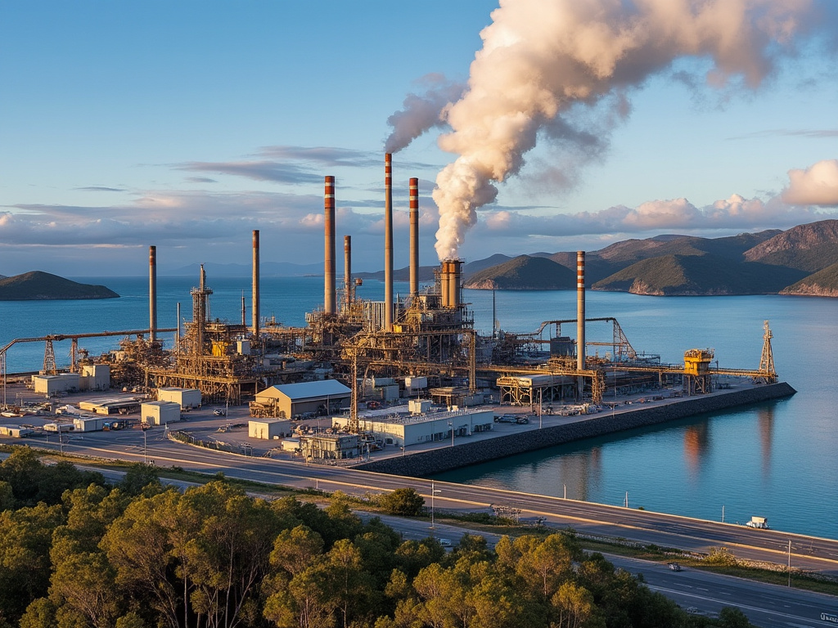
BACK in October the federal Labor and Tasmanian governments announced a $200 million support package for the state’s Bell Bay aluminium refinery after what the ABC called “a battle over power prices”.
It was the second aluminium smelter bailout in two months following the massive federal-NSW government $2.5 billion joint rescue package for Tomago, Australia’s largest aluminium smelter in the Hunter region, in August.
And before that was Whyalla steel: $2.6b; Boyne Island: $2.5b; Mt Isa + Townsville copper: up to $600m. Other bailouts: $400m+
What the ABC euphemistically called “a battle over power prices” was simply the problem of power prices being too high for profitable industrial production thanks to the stupid Net Zero targets and the “clean energy transition” that has produced an unstable and often expensive electricity supply system.
This notion that only “clean energy” should be financially supported is enforced by the Clean Energy Finance Corporation, which started financing “clean green energy” projects in 2013 under under the Clean Energy Finance Corporation Act 2012, which the Coalition, to its credit, opposed and attempted to abolish.
The CEFC was tapped by the federal government to provide a “concessional debt facility” to help Snowy Hydro to “underwrite and secure new renewable, affordable clean power” for the Tomago smelter in NSW.
Coal-fired power stations deliver continuous, high-volume baseload electricity around the clock, whereas Snowy Hydro acts like a battery with a fast-start peaking generator that supplies only a tiny fraction of total annual electricity for Australia.
This hydro power depends very much on variable water availability and lake levels, so to finance that in preference to coal-fired electricity on the basis of it being “clean” is ideological nonsense.
Wind and solar are similarly unpredictable. This generation system ranges from abundant and cheap in the middle of sunny, breezy weather when the wind and solar farms are pumping out electricity, to high prices in early-morning and night-time peak periods when gas and coal-fired power kicks in to fill the gaps.
This unstable and unpredictable system has priced big industry out, and then has billed Australians for the rescue.
Smelters need a steady, predictable and abundant supply of inexpensive electricity in order to compete with China, which has some 1195 coal-fired power stations, providing exactly that sort of electricity to its industrial hubs.
Unlike China, Australia’s political leaders believe they have a holy calling to abide by Paris Accord principles and reduce the consumption of coal and oil and shut down coal-fired power stations, which essentially means deindustrialization.
The Greens, of course, are all for deindustrialization and naively imagine a “green economy” and tout all sorts of new “industries” like eco-tourism, fake food factories, juice cafes and dog walking.
Labor, who supposedly represent the nation’s working people, have an ideological commitment to the industries and jobs their unions service, and now they face the harsh reality of seeing that industry on the brink of failure due to a fragmented, inefficient and often expensive electricity supply system.
So Labor’s response is to dig into the public purse and spend nearly $9b to subsidize those industries’ electricity supply.
In Tasmania the $200m deal will support operations through to 2031 and protect about 550 direct jobs in addition to the broader local supply-chain and indirect employment.
The importance of a heavy industries like aluminium, iron, copper and other base metals smelting can be seen in the national statistics:
Aluminium: IBISWorld reports 3012 workers in aluminium smelting in 2026, while the Australian Aluminium Council states the wider aluminium sector directly employs more than 21,000 people (including about 6600 full-time equivalent contractors) across mining, refining, and smelting.
Iron & Steel: IBISWorld puts employment in iron smelting and steel manufacturing at 16,725 in 2026.
Other Base Metals (Copper, Zinc, Lead): Major individual smelters also account for substantial regional workforces—such as about 550 direct staff shared across Glencore’s Mount Isa copper smelter and Townsville copper refinery, about 550 direct workers at Nyrstar’s Hobart zinc smelter in Tasmania, and around 800 direct workers at Nyrstar’s Port Pirie smelter in South Australia.
In an interview with the ABC (link above) the CEFC’s director Tim Buckley actually supported the subsidies for aluminium smelting which he described as “one of Australia’s top value-adding exports and of national security significance”.
He also noted that China had vastly increased its smelting capacity and now had a more than 50% share of the global aluminium smelting and refining market with increasing investment in Indonesia.
Asked how important power supply was to these industries, Buckley said it was “absolutely central to the smelting of aluminium” and the cost of electricity was the number one input into the refining process “and so without cheap, clean energy with 100% reliability you are not going to have an aluminium industry”.
Buckley’s summary of the industry is 95% real, but notice he added the word “clean” to the equation, which of course, rules out the most reliable supplier of bulk electricity – coal fired power stations.
And then Buckley added the proverbial (green ideological) turd in the salad: “I would argue that the world has to decarbonise. We have to see the Australian economy pivot to sustainable, clean industries of the future and we do have a global competitive advantage when it comes to renewable energy.
“But at the moment only Europe and the UK have a firm price on carbon pollution in the form of a national ETS (Emissions Trading Scheme) and also the Carbon Border Adjustment Mechanism (CBAM) which means European industry is protected from dirty imports of industrial products.”
Buckley’s “solution” is for the Australian government to push for an Asian CBAM to allegedly stop “dirty” industrial products from entering our country – “dirty” being the rather silly, derogatory term for “fossil fuel-based” products.
Would that include all the Chinese vehicles, wind turbines and solar panels flooding into Australia? After all, their products are mass produced thanks to China’s abundance of cheap 24×7 coal-fired electricity.
Of course Buckley and others of his “clean energy” cult will tell you that China is investing big time in “renewable energy”.
Officially coal is still the largest single source of power in China, “though its generation share has declined as renewables scale up” an AI response tells us, citing mainstream sources.
It added however, “China also continues to commission new coal capacity for grid stability and backup alongside record clean energy additions.”
Yes, China is adding to its phenomenal coal-fired power capacity from 1195 power stations at the last count as countries like Australia, the UK and Germany were foolishly shutting theirs down.
The UK, leading the way in woke environmental stupidity and virtue signalling, shut down or converted to alternative energy all 25 of their coal-fired power stations between 2000 and 2024, to be replaced primarily by wind and solar energy, supported by biomass conversions, natural gas for backup, and subsea electricity interconnectors to neighbouring European countries.
And despite assurances from the “clean energy” cult that this electricity would be “clean, green and inexpensive”, official sources show UK household electricity unit rates remain about 45% to 50% higher than pre-2021 levels and are set to climb sharply again in January 2027 due to Middle East gas disruptions.
Labour, the Conservatives, and the Liberal Democrats all backed the policy changes that drove coal off the British grid between 2008 and 2024, which confirms the subversive, globalist nature of the so-called “transition to renewables” pushed by big-shot backroom bureaucrats, the UN, NGOs and corporate-funded environmental think tanks.
The complicity of the UK “Conservatives” in this destruction of energy capacity came in 2015, when Conservative Energy Secretary Amber Rudd announced the formal 2025 deadline to close all remaining unabated coal plants.
Boris Johnson’s government subsequently brought that deadline forward to October 2024, and the final plant Ratcliffe-on-Soar, closed shortly after Labour returned to office in 2024.
Similarly, the Australian Liberal-National Coalition pushed ahead with “decarbonisation” policies in cahoots with Labor because that was the message that came down from above from those same global NGOs, UN bureaucrats, G20 agreements, etc, etc.
Under pressure from the rising One Nation support, the Coalition is now talking about abandoning the Department of Climate Change and Energy.